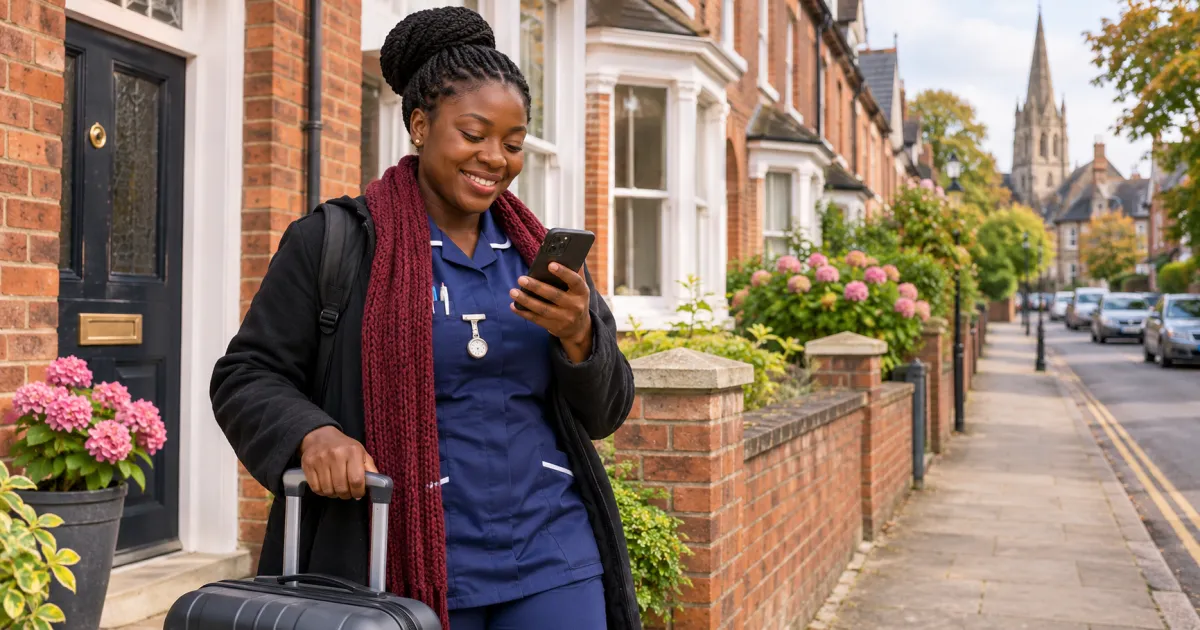
Your first month in the UK is mostly paperwork that unlocks everything else. In order: sign in to your UKVI account and check your eVisa, prove your right to work, apply for a National Insurance number, open a bank account, get a SIM, register with a GP and secure a home. None of these steps costs money with the government, and most can be done online.
Week one: your eVisa is your ID
The UK no longer issues most migrants a plastic card. GOV.UK explains that eVisas have replaced physical immigration documents, and you see yours through a free UK Visas and Immigration account. Before you fly, make sure the passport you will travel on is linked to that account, because airlines and Border Force check it.
Whenever someone needs proof of your status, you create a share code online. Each code lasts 90 days, and you can make a new one at any time. Employers use it to check your right to work, and landlords in England use it for right to rent checks. Write down your UKVI login details somewhere safe: losing access in the first weeks causes real delays.
National Insurance number
You need a National Insurance number for tax and your state pension record. If you lived in the UK before you may already have one, because the number stays the same for life. If not, you can apply online once you live in the UK and have the right to work. It can take up to 4 weeks to arrive, but you may start work before it comes, as long as you can prove your right to work. Until it arrives your employer may put you on an emergency tax code, which is corrected later.
Bank account
Most employers pay salaries only into a UK bank account. The usual problem is proof of address, which new arrivals rarely have. Ask your employer for a letter confirming your job and address, and ask banks about basic accounts, which have no overdraft and are designed for people with a short UK history. Some digital banks open accounts using your passport and eVisa alone. Keep money from home on a card you can use in the first weeks.
SIM card and phone number
Pay as you go SIM cards are sold in supermarkets and at airports, and you can switch to a monthly contract later. A UK number matters early: banks, GP surgeries and employers send codes by text. Contracts usually need a credit check, which a newcomer may fail, so start with a SIM only plan without a long commitment.
Registering with a GP
Do this before you get sick. The NHS says anyone in England can register with a GP surgery for free, and you do not need ID, proof of address or proof of immigration status to do it. Most surgeries accept online registration. Once registered, you can book appointments, get prescriptions and be referred to hospitals.
Finding a home
Many people start in short stays or rooms while they learn the area. In England, a landlord must check your right to rent before the tenancy starts, using either a share code or your original documents, and they cannot reject you for choosing one over the other. Scotland, Wales and Northern Ireland do not run this check.
Tenancy law in England changed in 2026. Assured periodic tenancies replaced assured shorthold tenancies on 1 May 2026, and your landlord must put any deposit in a government approved scheme within 30 days of receiving it. Ask which scheme holds yours and keep the certificate. Never pay a deposit for a home you have not seen, in person or by live video call.
Council Tax and bills
Once you have a home, register for Council Tax with your local council unless your rent includes it. Then set up gas, electricity, water and internet, or confirm that your landlord handles them. Take meter readings and photos on the day you move in.
A simple checklist
By the end of the month you should have: a working UKVI account and share code, a National Insurance number or an application in progress, a UK bank account receiving your pay, a UK phone number, a GP surgery, and a home with a protected deposit. If one step stalls, the others usually still move, so do them in parallel.
Questions people ask
Do I still get a BRP card when I move to the UK?
No. Most people now have an eVisa, a digital record you view through a free UKVI account. Older cards may still be usable in some situations.
Can I start work before I have a National Insurance number?
Yes, if you can prove your right to work. The number can take up to 4 weeks to arrive.
Do I need proof of address to register with a GP?
No. The NHS says you do not need ID, proof of address or proof of immigration status to register in England.
How long does a share code last?
A share code lasts 90 days. You can create a new one whenever you need it.
Does my landlord have to protect my deposit?
In England and Wales, yes for assured periodic tenancies. It must go into an approved scheme within 30 days.
Official sources: GOV.UK: eVisas, access and use your online immigration status, GOV.UK: View your eVisa and get a share code, GOV.UK: Apply for a National Insurance number, GOV.UK: Prove your right to rent in England, GOV.UK: Tenancy deposit protection, NHS: How to register with a GP surgery, GOV.UK: Council Tax, GOV.UK: Prove your right to work to an employer