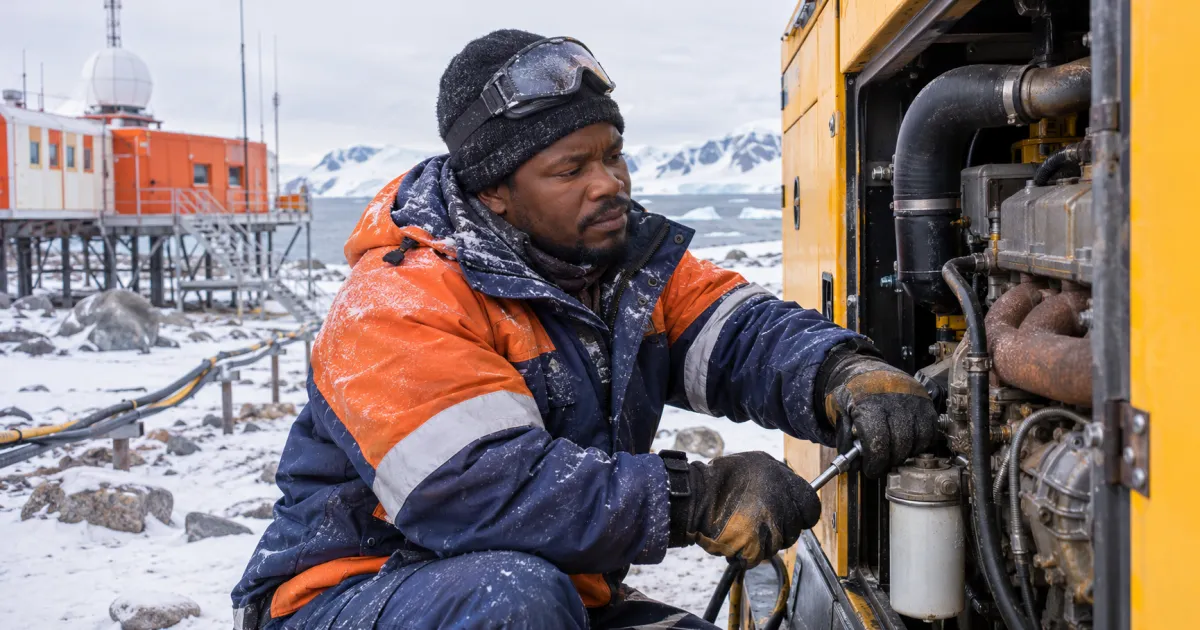
Most people who work in Antarctica are not scientists. Research stations run like small towns, so national programmes hire electricians, diesel mechanics, plumbers, chefs, doctors, communications technicians, meteorological staff and station leaders. The catch for foreign workers is nationality: each station is run by one country's programme, and most of them recruit their own citizens first. Your realistic route depends on your passport and your trade.
Who runs the stations and who they hire
Antarctic jobs come through national programmes or their contractors, not through open private employers. Three examples show how differently they work.
Australia. The Australian Antarctic Division runs three stations in Antarctica, Casey, Davis and Mawson, plus one on sub-Antarctic Macquarie Island. According to its guidance for applicants, each station needs station leaders, tradespeople, scientists, doctors, chefs and communications experts. Staff are public servants, and the law requires them to be Australian citizens. Non-citizens are generally considered only if no suitable Australian applies, with Australian residents with work rights and New Zealand citizens next in line. Some ICT and telecommunications roles need a security clearance that only citizens can get.
United States. The U.S. Antarctic Program hires support staff through the Antarctic Support Contract managed by Leidos, which takes both full-time employees and seasonal contractors. Other contractors cover food and station services, waste management and lodging, while a university medical branch hires physicians and medical support staff, and the U.S. Navy's partners recruit air traffic controllers and meteorologists. Applicants need the right to work for these US employers.
South Africa. The South African National Antarctic Programme is the clearest option for African candidates who hold South African citizenship or residence. Its SANAE IV station recruited a medical doctor, communications engineer, diesel mechanic, mechanical engineer, instrumentation technician, senior meteorological technician and electro mechanical technician for the 2026 to 2028 team. The team stays about 14 months, with no option to return home before February 2028. The Marion Island 2027 to 2028 team on the sub-Antarctic Prince Edward Islands advertised for communications and electrical engineers or technicians, meteorological technicians, environmental officers and seabird field assistants. Applications go through the Department of Forestry, Fisheries and the Environment's e-Recruitment system.
New Zealand's Scott Base is managed by Antarctica New Zealand, which advertises base roles in recruitment rounds on its careers page. Other countries with stations, including India, China and several European nations, mostly staff them through their own polar institutes.
What gets you hired
- A trade or professional licence. Electricians, plumbers, carpenters, diesel and heavy plant mechanics, chefs and doctors are always needed. The position description lists the licences required, and you must hold them.
- Experience in remote or harsh settings. Mining camps, offshore rigs, ships, military service or rural clinics show you can work far from support.
- The right personal qualities. Australia assesses every candidate against personal qualities such as teamwork, initiative, emotional awareness, respect for diversity and adaptability, at an assessment centre.
- Fitness and health. Every programme requires strict medical and psychological screening.
- Willingness to do community work. Expeditioners share kitchen duty, cleaning and rubbish clearance, clear snow and handle cargo, whatever their main job.
How long recruitment takes
Plan a year ahead. The Australian Antarctic Division says selection can take up to 9 months and includes a written application, medical checklist, technical interview, personal qualities assessment and medical and psychological checks. Candidates who complete a medical abroad may have to pay up to $2,000 upfront, with reimbursement later. Applicants found suitable can join a merit pool and be considered again in the following two seasons without repeating every step.
Remote stations closer to home
If Antarctica is out of reach because of nationality, similar skills are in demand at remote mining sites, offshore platforms, weather stations and island research bases. These jobs build exactly the record that polar programmes look for, and they are often open to workers from many countries.
Practical steps
- Check which programme your citizenship or residence lets you join.
- Sign up for job alerts on that programme's site, because rounds open once a year.
- Get your licences, first aid certificate and medical history in order before you apply.
- Talk to your family about months of separation with limited contact.
Questions people ask
Can foreigners work in Antarctica?
It depends on the programme. Australia generally hires its own citizens first, the US hires through American contractors, and South Africa recruits through its national environment department. Your passport usually decides which programme you can join.
What jobs are there in Antarctica besides science?
Stations hire electricians, plumbers, diesel mechanics, chefs, doctors, communications and IT technicians, meteorological technicians and station leaders.
How long is a winter posting in Antarctica?
Overwintering teams stay for many months. South Africa's SANAE IV team serves about 14 months with no return home before the end of the deployment.
How long does Antarctic recruitment take?
The Australian Antarctic Division says selection can take up to 9 months, with interviews, a personal qualities assessment and medical and psychological checks.
How can I prepare for an Antarctic job?
Hold the licences for your trade, build experience in remote work such as mining camps or ships, stay fit, and sign up for job alerts with the programme you are eligible for.
Official sources: Australian Antarctic Division: Essential information for all applicants including recruitment timeline, Australian Antarctic Division: Pathways to apply, Australian Antarctic Division: Expeditioner personal qualities, U.S. Antarctic Program: Jobs and opportunities, SANAP: Job opportunities at SANAE IV, Antarctica, SANAP: Marion Island 2027 to 2028 overwintering team vacancies, Antarctica New Zealand: Careers